

I. Khái niệm nền tảng
1. BET – Ba trụ cột tâm thức quản trị
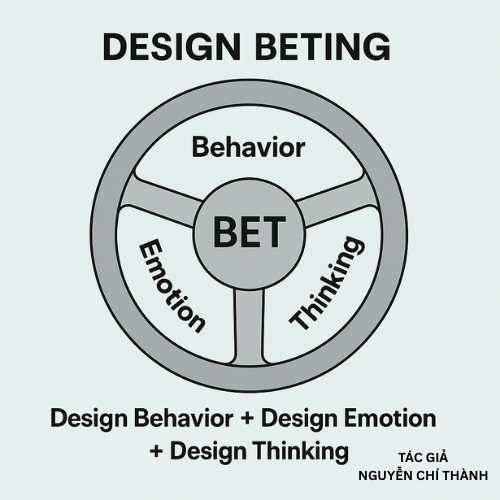
- Behavior (Hành vi):
Hành động, quyết định, phong cách lãnh đạo của CEO. Đây là phần “nhìn thấy được” của lãnh đạo – tương ứng với khái niệm Visible Leadership trong lý thuyết của John Kotter (Leadership vs. Management).
- Emotion (Tâm cảm – Tâm huyết & Cảm xúc):
Năng lực cảm nhận, truyền cảm hứng và dẫn dắt cảm xúc tập thể. Gắn liền với Emotional Intelligence (Daniel Goleman) và Resonant Leadership (Boyatzis).
- Thinking (Tư duy):
Hệ thống lý trí, logic, tư duy phản biện (Critical Thinking – Edward Glaser) và tư duy hệ thống (Systems Thinking – Peter Senge).
BET không chỉ là “làm” (do) mà còn là “hiện diện và dẫn dắt” (be & lead). Đây chính là tâm thức quản trị điều hành – tầng sâu nhất trong bản thể lãnh đạo.
2. Design BETING – Bước tiến mới
Lấy cảm hứng từ Design Thinking (Stanford d.school, Tim Brown – IDEO), nhưng mở rộng thành ba tầng thiết kế tâm thức:
+ Design Behavior: Thiết kế hành vi lãnh đạo, xây dựng bộ chuẩn mực ứng xử CEO – tổ chức – xã hội.
+ Design Emotion: Thiết kế cảm xúc & bầu khí quyển văn hoá doanh nghiệp, liên hệ đến Experience Economy (Pine & Gilmore).
+ Design Thinking: Thiết kế tư duy khai phóng, giải quyết bài toán phức hợp (wicked problems)
=> Design BETING chính là bánh lái của BizCar, nơi CEO không chỉ “think differently” mà còn “feel differently” và “act differently”.
II. Soi chiếu học thuật toàn cầu
Kotter & Drucker (Hành vi – Behavior):
Drucker: “Culture eats strategy for breakfast.” Nếu hành vi lãnh đạo không chuẩn, mọi chiến lược đều thất bại. BET nhấn mạnh việc thiết kế hành vi đi song hành cùng chiến lược.
Daniel Goleman (Tâm cảm – Emotion):
EQ chiếm đến 80% thành công lãnh đạo (Goleman). BETING nâng cấp điều này thành thiết kế cảm xúc tập thể – kiến tạo năng lượng tích cực.
Herbert Simon & Tim Brown (Tư duy – Thinking):
Simon (Nobel, 1978) khai phá “design as a way of thinking”. Tim Brown (IDEO) đưa thành Design Thinking. BETING bổ sung Behavior & Emotion để khắc phục hạn chế “tư duy thuần lý trí”.
Peter Senge (Systems Thinking):
Trong The Fifth Discipline, Senge nhấn mạnh tư duy hệ thống. BETING kế thừa và mở rộng: CEO không tách rời hành vi – cảm xúc – tư duy mà nhìn như một hệ sinh thái tâm thức.
Karl Weick (Sensemaking):
Lãnh đạo không chỉ là quyết định, mà còn là tạo ý nghĩa. BET chính là cấu trúc sensemaking:
• Hành vi (làm gì)
• Cảm xúc (cảm thấy thế nào)
• Tư duy (hiểu ra sao).
III. Mô hình BETING trong BizCar
1. Cấu trúc Bánh lái CEO
- Vành lái: BET
- Trục lái: KORA .
- Hướng lái: Mission
2. Ứng dụng thực tiễn
+ Design Behavior: CEO thiết kế các rituals (nghi thức quản trị) như: khung họp đầu tuần, nguyên tắc phản hồi minh bạch, văn hoá kỷ luật & trách nhiệm.
+ Design Emotion: Tạo trải nghiệm Positive Energy – ứng dụng Positive Psychology (Seligman) vào đời sống doanh nghiệp.
+ Design Thinking: Áp dụng empathy map, prototyping, system mapping để giải quyết bài toán chiến lược & vận hành.
IV. Phản biện & Bổ sung
Điểm mạnh
+ BETING vượt giới hạn của Design Thinking khi chỉ tập trung vào tư duy.
+ Phù hợp đặc biệt với văn hoá châu Á, nơi cảm xúc & hành vi gắn chặt với văn hoá cộng đồng.
Điểm cần tinh chỉnh
+ Nguy cơ kỹ thuật hoá: Behavior & Emotion có thể bị áp dụng như “kỹ thuật giả tạo” nếu thiếu authentic leadership (George, 2003).
+ Thiếu đạo đức: BETING cần tích hợp Ethics (Đạo đức quản trị) để tránh việc CEO “thiết kế cảm xúc” theo hướng thao túng.
V. Kết luận Triết nghiệm
+ Design Thinking: công cụ đổi mới.
+ Design BETING: la bàn lãnh đạo – giúp CEO hành động chuẩn mực, truyền cảm hứng chân thành, tư duy khai phóng.
Triết nghiệm Gia Nguyễn Chí Thành:
“Bánh lái CEO không chỉ để rẽ hướng, mà để dẫn dắt cả doanh nghiệp vượt sóng gió thời đại.”
=================================
INTERNATIONAL ACADEMIC EDITION
DESIGN BETING
(Original Author: Nguyen Chi Thanh – The Experiential Philosopher-Triet Nghiem Gia)
I. Foundational Concept
1. BET – The Three Pillars of Executive Mindset
-
Behavior:
The visible leadership actions – decisions, behaviors, and styles. Resonates with Visible Leadership (John Kotter) and Authentic Leadership (Bill George).
-
Emotion:
The ability to sense, inspire, and lead collective emotions. Anchored in Emotional Intelligence (Daniel Goleman) and Resonant Leadership (Richard Boyatzis).
-
Thinking:
The cognitive foundation – critical reasoning (Edward Glaser), systems perspective (Peter Senge), and reflective sensemaking.
BET defines the Executive Mindset: not just doing but being and leading.
2. Design BETING – The Next Leap
Inspired by Design Thinking (Stanford d.school, Tim Brown – IDEO), but expanded into a holistic design of leadership mindset:
-
Design Behavior: Crafting leadership behaviors and ethical norms for CEOs, organizations, and society.
-
Design Emotion: Designing emotional climates and cultural atmospheres (Experience Economy – Pine & Gilmore).
-
Design Thinking: Designing cognitive processes to solve wicked problems.
Design BETING = The Steering Wheel of the CEO – enabling leaders not only to think differently but also to feel differently and act differently.
II. Global Academic Reflection
-
Kotter & Drucker (Behavior): Culture and leadership behavior are the foundation of strategy.
-
Daniel Goleman (Emotion): EQ drives up to 80% of leadership success.
-
Herbert Simon & Tim Brown (Thinking): From “design as a way of thinking” to Design Thinking, extended into BETING.
-
Peter Senge (Systems Thinking): BETING as an integrated system of behavior, emotion, and thought.
-
Karl Weick (Sensemaking): BET as the architecture of meaning-making:
-
Behavior → what leaders do
-
Emotion → how they and others feel
-
Thinking → how they make sense of complexity.
-
III. The BETING Steering Wheel Model (BizCar Framework)
-
Wheel Rim: BET (Behavior – Emotion – Thinking).
-
Wheel Axis: KORA (Key Operating & Reflective Axis – Core Values & Self-reflection).
-
Wheel Direction: Mission – the long-term vision & purpose.
Applications:
-
Design Behavior: Leadership rituals – transparent decision-making, weekly check-ins.
-
Design Emotion: Building Positive Energy Workplaces, drawing from Positive Psychology (Martin Seligman).
-
Design Thinking: Employing empathy maps, ideation, prototyping to drive innovation.
IV. BET Evaluation Framework
1. Behavior (30%)
-
Qualitative: Role modeling, authenticity, transformational vs. transactional leadership.
-
Quantitative: KPI adherence, 360° feedback, response transparency rate.
2. Emotion (35%)
-
Qualitative: Empathy, conflict management, emotional climate.
-
Quantitative: EQ-i 2.0 score, Engagement Index, attrition due to stress.
3. Thinking (35%)
-
Qualitative: Critical thinking, systems thinking, crisis sensemaking.
-
Quantitative: Watson–Glaser test, Cognitive Reflection Test (CRT), strategic decision success rate.
BET = hard data (quantitative) + soft data (qualitative).
V. BET Index – Measurement Method
BET Index = (BI \times 0.30) + (EI \times 0.35) + (TI \times 0.35)
-
85–100: Outstanding Executive Mindset – transformational leadership.
-
70–84: Effective Executive – good but requires refinement.
-
50–69: Average Executive – risk of “misaligned steering”.
-
<50: Crisis of Mindset – urgent redesign needed.
Measurement Process:
-
Standardized tests (EQ, Watson–Glaser, 360° feedback).
-
Ethnographic observation & executive interviews.
-
Operational data analysis (KPI, retention, strategy success).
-
Index normalization (0–100).
-
Benchmarking against industry peers.
VI. BET Development Roadmap for CEOs
-
Diagnosis: Measure BET Index.
-
Training & Coaching: Address weak dimensions (e.g., low EQ → emotional coaching).
-
Application: Practice through rituals, team projects, innovation sprints.
-
Reflection: Continuous 360° feedback and self-reflection.
-
Redesign: Iterative mindset renewal.This forms the BET Learning Cycle: Measure → Train → Apply → Reflect → Redesign.
VII. Philosophical Conclusion
-
Behavior → Discipline & consistency.
-
Emotion → Charisma & resonance.
-
Thinking → Vision & liberation.
“Developing BET is not about adding skills to a CEO, but about redesigning the very steering wheel of the inner self so that the enterprise vehicle can go farther and last longer.”
— Nguyen Chi Thanh, Triet Nghiem Gia